Writings · Photography — 15 min read
The Family Album as a Crime Scene
What if family photographs reveal less about what happened than about what was chosen to be remembered? A meditation on archives, absence, photography and the mysteries hidden inside family albums.
By Kobi Israel · · 15 min
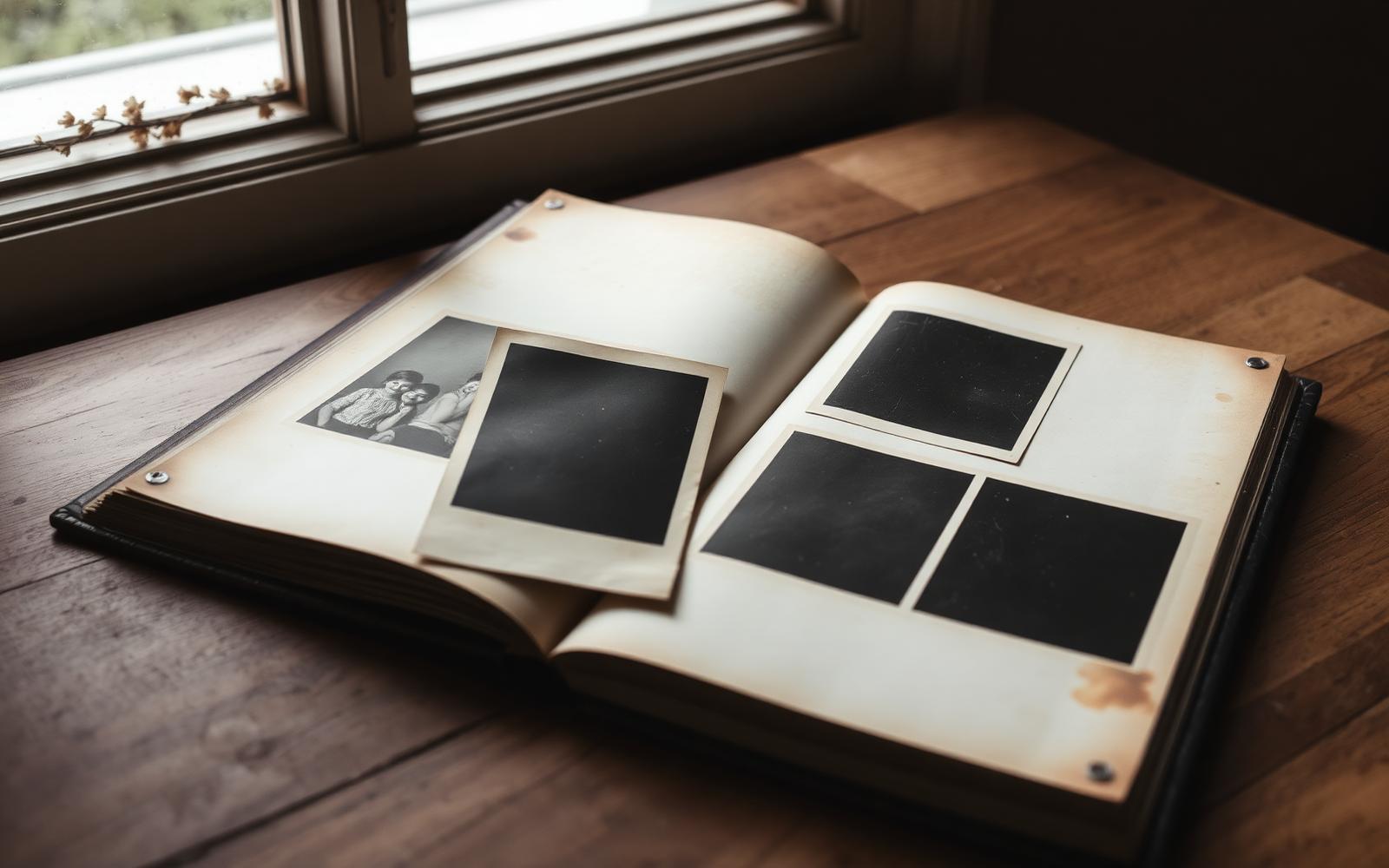
Every family album contains two histories. The first is visible. The second has been carefully removed. The longer we look, the more the family album begins to resemble a crime scene where the evidence is incomplete and the witnesses are unreliable.
Every family album contains two histories.
The first is visible.
The second has been carefully removed.
When we open an old family album, we rarely imagine ourselves entering a place of uncertainty. We expect familiarity. We expect reassurance. We expect photographs to confirm what we already believe about ourselves and those who came before us.
A family album appears trustworthy.
After all, the camera was there.
The photograph exists.
The faces are visible.
The evidence seems incontrovertible.
And yet the longer I spend with photographs, the less certainty they provide.
The family album increasingly resembles a crime scene.
Not because a crime necessarily occurred.
Because evidence is missing.
Every archive begins with a selection.
Someone chose this photograph.
Someone rejected another.
Someone preserved this moment.
Someone allowed another to disappear.
The family album therefore tells us as much about forgetting as it does about remembering.
This is what first struck me while sitting with my mother one afternoon, turning the pages of an ageing family album.
The photographs themselves were unremarkable. Birthdays. Relatives. Holidays. Children standing beside cakes. Adults standing beside cars. People smiling beneath the peculiar optimism demanded by family photography.
Nothing appeared suspicious.
And yet a strange feeling emerged.
The album seemed complete. Too complete.
The more I looked, the more I sensed an absence moving beneath the surface. Entire years appeared condensed into a handful of images. Certain relatives appeared repeatedly. Others barely appeared at all. Some stories dominated. Others seemed to have been erased entirely.
The album was not preserving a family. It was editing one.
This may be the first secret hidden within every archive. Memory is not an archivist. Memory is an editor.
An archivist preserves indiscriminately. An editor selects. Families do both simultaneously. They remember. They remove. They repeat. They omit.
Over time, these decisions become invisible. The surviving photographs begin to feel inevitable. As though they were always destined to represent the past.
But photographs are survivors. Their survival should never be mistaken for neutrality.
Every image that remains occupies a position previously occupied by another that did not. Each preserved photograph stands on the quiet grave of one that was discarded, lost, hidden in a drawer, removed from a wedding, cut out of a frame.
The album we inherit is not the album that once existed. It is a curated version, edited by hands we may never identify, according to motives we may never fully understand.
This is why family albums often reveal more about silence than about speech.
We notice the missing father. The aunt who appears only once, then vanishes. The child whose name no one wants to repeat. The years between two pages, where something must have happened, because the people on the second page no longer look at one another the way they did on the first.
A photograph cannot lie about what it shows. But it can lie by being the only thing left.
Every family preserves a story it can live with. Photographs are recruited into that story. They are sorted, captioned, displayed and reinterpreted until they support the version the family has agreed to remember.
The most powerful photographs in any album are often the ones that resist this process. The image that does not fit. The expression that contradicts the official narrative. The body language that betrays a tension no one ever named.
These are the photographs that make us pause.
Not because they reveal a secret. Because they admit there is one.
Detectives speak of crime scenes in a particular way. They look for what is present. They look for what is absent. They notice disturbances. They reconstruct sequences. They distrust the obvious.
Looking at a family album with the same attention transforms the experience entirely.
Suddenly the empty page becomes evidence. The photograph removed from its corners leaves four small marks that resemble fingerprints. A torn edge becomes a wound. A scratched-out face becomes testimony. A repeated background becomes a habit, then an obsession, then a clue.
The album begins to confess.
Not the truth. Something more complicated. The shape of what the family could not bear to keep.
Roland Barthes wrote that the photograph is a certificate of presence. This has been. But the family album reminds us that presence is always selected. Someone decided what would have been.
We inherit the verdicts of people who are no longer here to defend their choices.
We inherit their tenderness. We inherit their cowardice. We inherit their love and their evasions in equal measure, bound together in the same leather cover.
And yet there is nothing cynical in this. To edit an album is, in part, an act of protection. Families remove what is painful because pain, repeated, becomes unbearable. They keep what is bright because brightness, repeated, becomes a kind of shelter.
The family album is not only a crime scene. It is also a refuge. The two are not contradictory. Both are responses to the same problem. The problem of how to live with a past too large to fully remember and too important to fully forget.
What we eventually inherit is neither truth nor lie. It is shape. The shape a family gave to its own existence in order to continue.
Some albums close that shape tightly. Others leave it deliberately open. The most generous albums I have seen are the ones that leave a few mysteries intact. A photograph without explanation. A face the family no longer recognises. A landscape no one can place.
Mystery, in an archive, is a form of honesty.
It admits that the past exceeds us. That it cannot be fully owned. That somewhere, behind every photograph, there are rooms we will never enter and conversations we will never overhear.
When I close an old album now, I no longer feel I have visited the past. I feel I have visited a scene that someone, long ago, prepared for my arrival.
I am the latest investigator. I am also the latest editor.
The photographs I keep. The ones I move to the back. The ones I quietly remove. The captions I add. The captions I never write. These too will become part of the archive that someone else, decades from now, will open with the same uncertain reverence.
They will look for clues. They will notice absences. They will reconstruct a family from incomplete evidence.
And the album, as it always does, will tell them something true and something untrue at the same time.
It will say: this happened.
And, more quietly: this was allowed to remain.
Parallax Letters
Receive new investigations by post.
Related Essays