Writings · Film — 12 min read
The Diary as Cinema
What if a diary is not a book but a film? An exploration of personal archives, notebooks, photography, travel and the cinematic possibilities hidden within everyday life.
By Kobi Israel · · 12 min
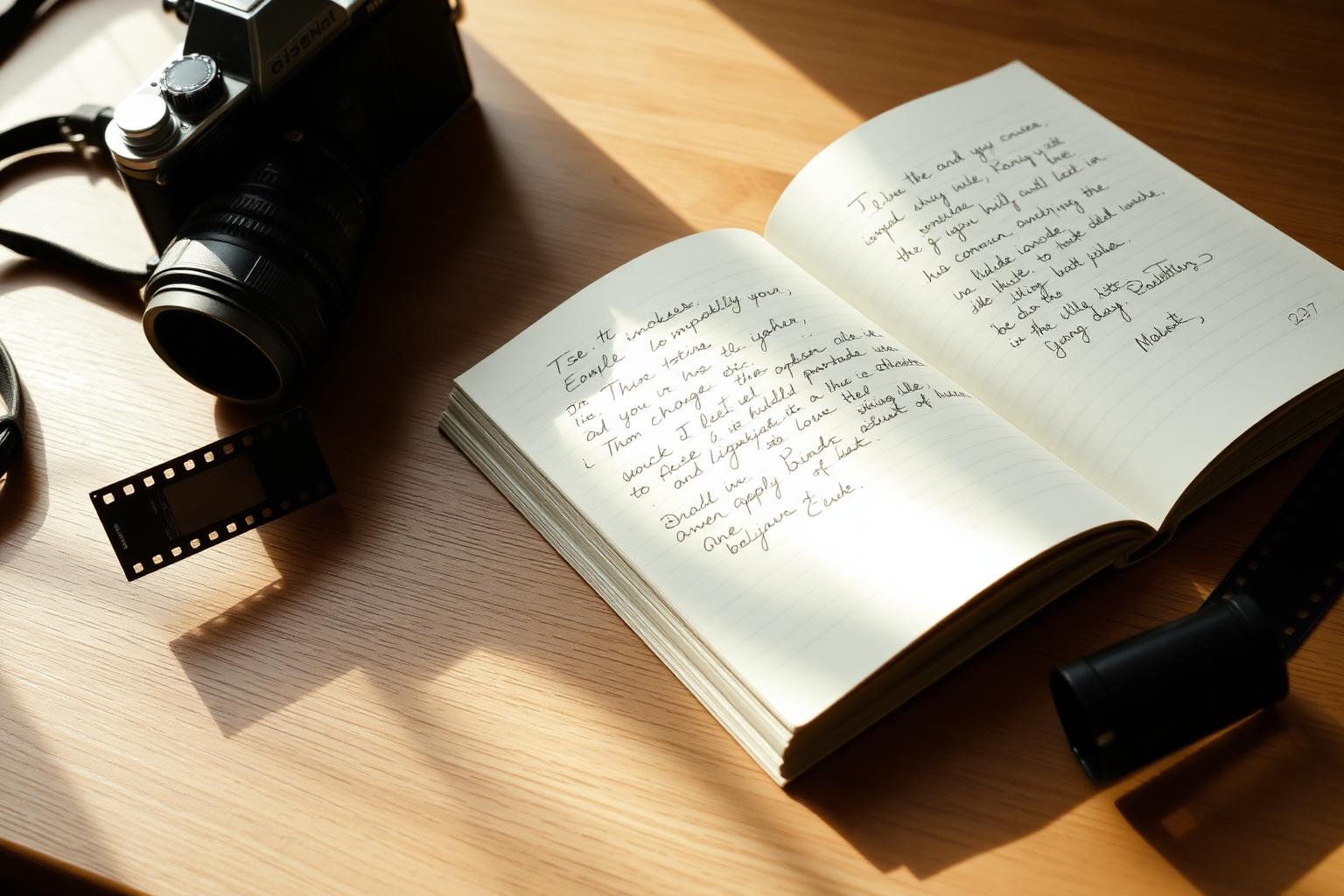
The notebook sat beside my bed for years before I understood what it was. At the time, I thought I was keeping notes. Fragments. Observations. Addresses. Sentences overheard on trains. Descriptions of light entering rooms. Small details gathered from ordinary days. Nothing appeared significant. Most entries occupied only a few lines. A date. A place. A feeling. The notebook seemed incomplete. Perhaps all diaries do.
Years later, while reading those pages again, I realised I had misunderstood their purpose. The notebook was not recording my life. It was editing it. The entries functioned like film cuts. One moment beside another. One image beside another. Meaning emerging in the gap.
This was when I began wondering whether a diary and a film might be closer relatives than they appear. Both collect fragments. Both depend upon selection. Both transform lived experience into narrative. Both attempt something impossible: to preserve the movement of consciousness.
The diary and the film inevitably fail. And yet the failure remains beautiful. The effort itself becomes meaningful.
Perhaps this is why so many filmmakers eventually gravitate toward diaries. And why so many diarists secretly become filmmakers. The distance between the two forms is remarkably small.
A diary records days. Cinema records duration. A diary assembles moments. Cinema assembles moments. Both ask the same question: How can experience be preserved without destroying it?
The question haunted much of twentieth-century cinema. Few filmmakers explored it more profoundly than Jonas Mekas. Mekas transformed everyday life into a cinematic diary. Birthdays. Conversations. Friends. Journeys. Meals. Nothing appeared dramatic. Nothing appeared historically important. And yet the films felt extraordinary. Not because of what they documented. Because of how they looked. The camera moved like memory. The images flickered. Moments appeared and vanished. Life remained unfinished. The films refused certainty. Watching them felt less like observing events than remembering them.
This fascinated me because it mirrored my own relationship to photography. For years I carried a camera while travelling. India. Japan. Cuba. Hungary. Romania. Places accumulated inside hard drives and boxes. Thousands of photographs. Hundreds of short videos. Train stations. Hotel rooms. Conversations. Streets after rain.
At first I imagined I was creating an archive. Later I realised I was creating a diary. The distinction mattered. An archive preserves. A diary interprets. The images were not objective records. They reflected attention. They revealed what repeatedly attracted my gaze. A particular kind of light. A recurring loneliness. A fascination with departures. The camera was recording more than the world. It was recording the shape of my curiosity.
This may be the hidden subject of every diary. Not events. Attention. A diary tells us what someone noticed. And what someone noticed reveals who they were.
The same principle applies to cinema. The camera points. The choice reveals a consciousness. A filmmaker filming rain for three minutes tells us something. A filmmaker filming a crowded street tells us something else. The subject matters. The attention matters more.
Several years ago, while reviewing old travel footage, I noticed something peculiar. The films contained very little of what guidebooks considered important. Famous landmarks appeared briefly. Tourist attractions barely appeared at all. Instead, the footage lingered on details. A woman waiting at a bus stop. Laundry moving in wind. Passengers sleeping on trains. The reflection of a city inside a window. At first I worried I had documented the wrong things. Then I realised those details were the journey. The guidebook described geography. The diary described experience.
Cinema, at its most personal, behaves similarly. It records not what happened. But how reality felt.
This insight became increasingly important as smartphones transformed everyday life into a continuous act of documentation. Human beings now record themselves constantly. Millions of photographs. Millions of videos. Millions of fragments. The archive expands endlessly. Yet something curious often happens. The more we document, the less we remember.
The problem is not abundance. The problem is attention. Recording becomes automatic. Observation becomes secondary.
The diary as cinema offers an alternative. A slower practice. A more deliberate one. The objective is not accumulation. The objective is noticing. Not every moment deserves preservation. Certain moments deserve attention. The difference is subtle. The consequences are enormous.
This is why the greatest diary films often feel intimate despite their simplicity. They are built from observation rather than performance. The camera witnesses. It does not dominate. The filmmaker participates. But quietly. The resulting work feels less like autobiography and more like presence.
This is what I admire in filmmakers such as Jonas Mekas, Chris Marker and, in a different way, Agnès Varda. Their films never seem interested in proving importance. They remain interested in curiosity. A cat crossing a street. A stranger on a train. A forgotten photograph. The ordinary becomes meaningful through attention.
The diary and cinema meet precisely at this point. Both transform observation into memory.
Several years ago, I found an old notebook from a journey I barely remembered. The entries appeared insignificant. A weather report. A train departure time. A sketch. A single sentence describing a conversation. And yet reading those fragments restored entire worlds. The notebook functioned like cinema. The fragments generated movement. Images returned. Atmospheres returned. The self who wrote those words briefly returned. Not completely. Enough.
This incompleteness is essential. Neither diaries nor films preserve reality. They preserve traces. The trace remains active. The viewer completes the rest. The reader completes the rest. Memory collaborates. Meaning emerges.
Perhaps this is why diaries become increasingly valuable with age. The diary does not merely record the past. It creates conversations between different versions of the self. The person writing. The person reading. The years between them. Cinema performs the same miracle. The image survives. The observer changes. A new conversation begins.
Several decades from now, someone may open a notebook. Someone may watch a film. Someone may discover a photograph. The fragments will remain incomplete. The life will remain partially inaccessible. And yet something extraordinary may still occur. A connection. A recognition. A brief sense that another consciousness once occupied the world and attempted to describe what it felt like to be here.
Perhaps this is the true purpose of both diaries and cinema. Not preservation. Communication. A message carried across time. A fragment sent toward the future. A way of saying: I was here. I noticed this. I thought it might matter.
Parallax Letters
Receive new investigations by post.
Related Essays