Writings · Memory — 12 min read
Evidence That We Were Here
Perhaps every photograph, every diary, every journey and every story ultimately attempts to answer the same question: what evidence will remain that we were here?
By Kobi Israel · · 12 min
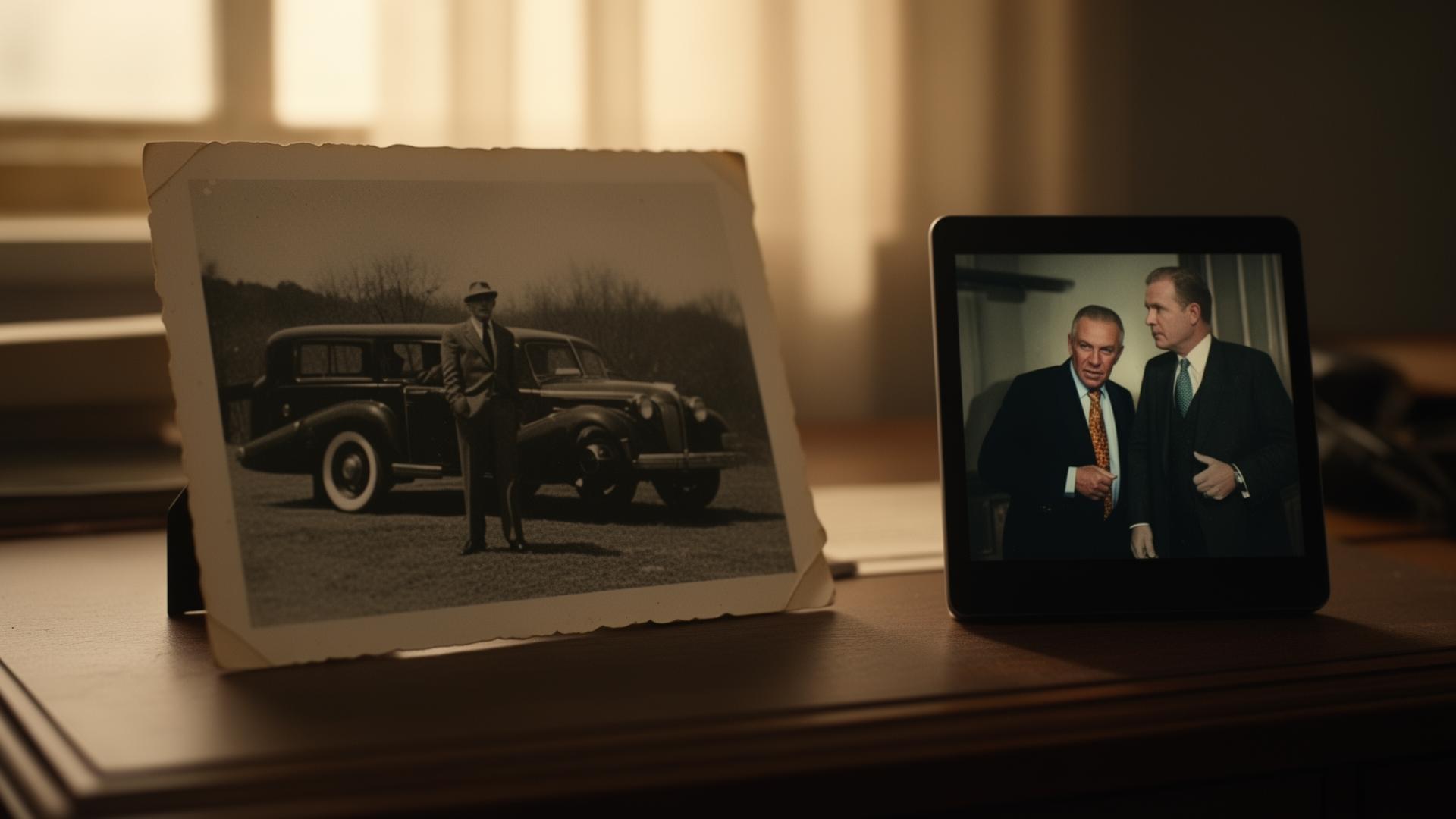
Several years ago, I found a photograph in a flea market.
The image was ordinary. A man stood beside a car. Behind him, a road disappeared toward an unseen destination. Nothing dramatic was happening. No historical event. No famous face. No explanation accompanied the photograph.
The man was anonymous. His story was absent. His future had already happened.
And yet I could not leave the photograph behind. I bought it without knowing why. Perhaps because the image contained a mystery that extended beyond the man himself.
The photograph had survived. The man had disappeared. The image remained.
I often think about that distinction. Every archive begins with a disappearance. A photograph survives because someone does not. A diary survives because its author is gone. A letter survives because the conversation ended. An old house survives because the people who filled it with life have moved elsewhere, grown older or died.
The trace remains. The source vanishes.
Human beings have always struggled with this imbalance. Long before photography, people built monuments, wrote histories, carved names into stone and painted portraits. Every civilisation developed its own methods for negotiating impermanence. The desire itself never changed. Only the tools evolved.
The fundamental question remained remarkably consistent: what evidence will remain that we were here?
The older I become, the more I suspect this question lies beneath much of human culture. Photography. Cinema. Music. Literature. Architecture. Family albums. Travel journals. Even casual conversations. Each represents a different attempt to leave traces behind. Not necessarily fame. Not necessarily recognition. Something more modest. Continuity. A bridge between one moment and another. A bridge between one life and another.
The previous essays in this series have circled around this idea from different directions. Childhood appeared as a country accessible only through memory. Photography emerged as a response to disappearance. Travel became a form of inheritance between generations. Queer archives revealed how traces survive even when histories are suppressed.
Each essay examined a different form of evidence. Each explored a different strategy against forgetting. Together they suggest a possibility. Perhaps memory itself is not the opposite of forgetting. Perhaps memory is the art of leaving traces.
This distinction matters. For most of human history, memory was imagined as preservation. We wanted to keep things intact. We wanted perfect recall. We wanted the past to remain available exactly as it had been. Experience suggests otherwise. Nothing remains unchanged. Photographs fade. Film deteriorates. Buildings collapse. Stories evolve. Archives fragment.
The past survives through transformation rather than preservation. The trace changes because the observer changes. Every generation rewrites what it inherits. Every reader reconstructs the text. Every viewer reconstructs the image. Every child reconstructs the story.
The evidence remains. The meaning moves.
As a photographer, I have often felt this tension. A photograph appears stable. The image fixes light into a permanent form. Yet permanence proves deceptive. The photograph does not preserve reality. It preserves a fragment. And fragments behave differently than wholes.
A fragment invites imagination. A fragment creates questions. A fragment requires participation.
Perhaps this explains why certain photographs remain fascinating while others become invisible. The most powerful images rarely answer questions. They generate them. Who was this person? What happened next? Why was this moment chosen? What remains outside the frame? The unanswered question becomes part of the artwork. The viewer completes what the image cannot provide.
Cinema operates according to a similar principle. Chris Marker understood this better than almost anyone. His films repeatedly suggested that memory is not a destination but a process. The image itself was never enough. Meaning emerged through movement between images. Between places. Between times. Between fragments. Watching his work often feels like exploring an archive assembled by uncertainty. The viewer becomes a traveller. Not through geography. Through memory.
This relationship between travel and memory has occupied much of my own life. Whenever I arrive in a new city, I am struck by how quickly places begin accumulating traces. A hotel room becomes memorable because of a conversation. A train station becomes significant because of a goodbye. A café becomes inseparable from a particular afternoon. The location absorbs experience. Years later, the memory returns through the place.
Travel therefore creates archives. Not institutional archives. Personal archives. Invisible collections of emotional geography. We carry entire cities within us. Not the cities themselves. Versions of them. Interpretations. Fragments. Evidence.
The same principle applies to family history. A family archive rarely contains complete stories. More often it contains clues. Photographs without names. Letters without context. Objects whose significance has been forgotten. A watch. A postcard. A recipe. A map. Each item functions like an archaeological fragment. The archive becomes an unfinished conversation between generations.
The remarkable thing is that incompleteness often increases emotional power. We are moved not despite the missing information but because of it. Absence creates space for imagination.
This is especially true within queer history. For generations, queer lives survived through traces rather than official recognition. Photographs. Letters. Rumours. Archives. The evidence often appeared fragile. Yet fragility proved surprisingly resilient. A single photograph could survive censorship. A single diary could survive silence. A single image could outlive prejudice. The trace continued travelling into the future. Waiting.
This may be the deepest lesson archives teach us. Survival does not require completeness. A fragment can be enough. A photograph can be enough. A sentence can be enough. A memory can be enough. The trace continues moving long after its creator disappears.
Perhaps this is why I continue photographing. Why I continue filming. Why I continue writing. Why so many people continue creating despite knowing that permanence is impossible. The objective is not immortality. The objective is participation. To contribute something to the ongoing conversation. To leave a few coordinates behind. A photograph. A story. A song. A film. Evidence. Nothing more. Nothing less.
Several years ago, I watched my son studying a photograph. He asked questions about people he had never met. A grandparent. A relative. Someone whose life belonged entirely to another generation. The photograph had become a bridge. Not a perfect bridge. Not a complete bridge. A sufficient bridge. The image allowed curiosity to travel where direct experience could not.
At that moment I understood something I had missed for years. Archives are not collections of the past. They are gifts to the future. The person taking the photograph rarely knows who will eventually see it. The writer never fully knows their reader. The filmmaker never meets most viewers. The creator works in uncertainty. Yet the work continues travelling. Crossing years. Crossing borders. Crossing generations. Eventually arriving somewhere unexpected.
This essay itself participates in that process. I do not know who will read it. I do not know when. I do not know what will survive. Perhaps only a sentence. Perhaps only an image. Perhaps nothing at all. Yet uncertainty has never prevented human beings from leaving traces. If anything, it provides the motivation. The future remains unknowable. The trace becomes an act of faith. Faith not in permanence. Faith in connection.
The photograph found in the flea market remains on my desk. I still know nothing about the man standing beside the car. His name remains absent. His story remains incomplete. Yet his photograph succeeded. Not because it explained his life. Because it continued it.
For a brief moment, decades after the shutter closed, another person stopped and looked. Another person wondered. Another person cared. The trace survived.
Perhaps that is all any of us can hope for. Not perfect remembrance. Not historical significance. Not immortality. Only this: that somewhere in the future, someone encounters a photograph, a letter, a film, a song or a story and pauses long enough to recognise that another life once occupied the world. Another consciousness stood beneath the same sky. Another heart experienced wonder, fear, desire, love and loss. Another human being was here. And left behind just enough evidence to prove it.
Parallax Letters
Receive new investigations by post.
Related Essays