Writings · Personal Investigations — 16 min read
The Photograph My Mother Didn't Expect to Find
A personal investigation into memory, photography and identity. What happens when a childhood photograph is removed from a family album and reappears in the world, waiting to be discovered by the person who once lived inside it?
By Kobi Israel · · 16 min
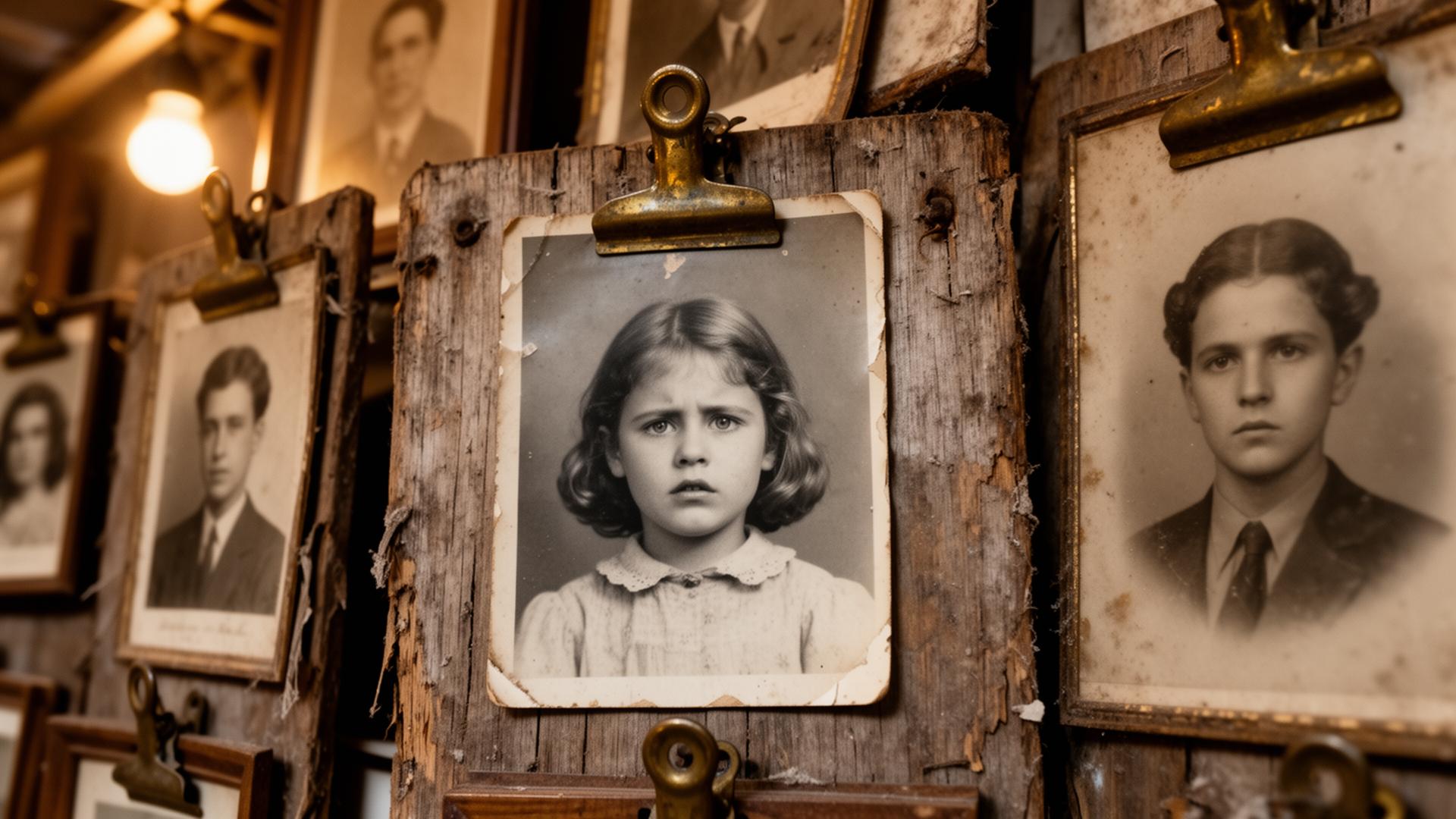
The photograph had spent most of its life in darkness.
Not complete darkness.
The soft darkness of family archives.
The darkness inside albums, drawers and boxes.
The darkness where memories wait.
For nearly seventy years, it remained there, pressed between other photographs that collectively claimed to tell the story of a life.
A little girl stood facing the camera.
The image was black and white.
The expression was uncertain.
The future remained invisible.
The girl was my mother.
One afternoon, without her knowledge, I removed the photograph from the album.
Months later, she found it hanging in an antique market.
This is the simple version of the story.
The truth is more complicated.
The truth always is.
I had become increasingly fascinated by the relationship between memory and evidence. Photography supposedly preserves reality, yet my experience suggested otherwise. Photographs seemed less interested in preserving the past than in continually rewriting it.
Every time we encounter an old image, we see something different.
The photograph remains unchanged.
The observer does not.
Memory evolves around the image like ivy around a building.
Eventually it becomes difficult to separate the original structure from the growth surrounding it.
I wanted to know what would happen if a photograph escaped its assigned narrative.
What would happen if a family photograph ceased being a family photograph?
What would happen if memory lost control of its evidence?
The experiment began with a single image.
My mother's childhood portrait.
I removed it from the album.
I placed it elsewhere.
Then I waited.
Several weeks later, while visiting an antique market, my mother stopped walking.
The interruption was subtle.
No dramatic reaction.
No immediate recognition.
Simply a pause.
A hesitation.
The sort of pause that occurs when reality momentarily loses confidence in itself.
She stared at the photograph.
Then she looked away.
Then back again.
People often imagine that memory functions like retrieval.
You search.
You locate.
You recover.
Watching my mother, I realised memory behaves differently.
Memory negotiates.
The mind does not immediately accept what it sees.
Instead, it compares the evidence before it against the stories it already believes.
The photograph created a conflict.
The image was familiar.
The context was impossible.
How could a childhood photograph she had always known to exist inside a family album suddenly appear among anonymous photographs belonging to strangers?
The photograph had violated its assigned geography.
It no longer occupied the correct location within reality.
The mind struggled to accommodate the contradiction.
This fascinated me.
Not because I wished to deceive her.
Because I wanted to observe the moment when certainty became unstable.
Every family possesses photographs that function as anchors. They help organise identity. They reassure us that our memories correspond, however imperfectly, to events that occurred.
The family photograph says:
This happened.
You were here.
The archive confirms existence.
Yet what happens when the photograph itself becomes unreliable?
What happens when evidence begins moving independently?
The longer I work with photography, the more convinced I become that photographs possess lives of their own.
Not literally.
Narratively.
Photographs travel.
They survive house moves, deaths, divorces, inheritances and accidents.
They pass between generations.
They disappear.
They reappear.
They acquire meanings their creators never intended.
A photograph is one of the few objects capable of outliving its original purpose.
The image begins as documentation.
It ends as archaeology.
Watching my mother examine the photograph, I realised something unexpected.
She was not trying to identify the image.
She had already done that.
She was trying to identify herself.
The photograph had become a mirror pointed backwards through time.
The little girl staring from the image occupied an increasingly distant relationship to the elderly woman studying her.
Both were the same person.
Neither fully recognised the other.
This may be one of photography's strangest powers.
Photographs collapse time while simultaneously revealing its existence.
The image insists that two incompatible truths coexist.
You were once this person.
You are no longer this person.
The contradiction cannot be resolved.
It can only be experienced.
Roland Barthes wrote that every photograph contains a kind of temporal wound.
The image confirms that a moment existed.
It simultaneously confirms that the moment has disappeared.
Watching my mother encounter her own childhood unexpectedly, I understood this idea differently.
The wound was not located within the photograph.
The wound was located between versions of the self.
The child.
The adult.
The elderly woman.
The photograph forced them into the same room.
Several days later I asked my mother about the experience.
Her answer surprised me.
She spoke very little about the photograph itself.
Instead she spoke about uncertainty.
About how strange it felt.
About the brief sensation that reality had become less reliable than she previously believed.
The photograph had introduced doubt.
Not destructive doubt.
Productive doubt.
The kind that encourages curiosity.
The kind that invites investigation.
The kind that asks whether our memories are possessions or relationships.
The distinction matters.
Possessions remain fixed.
Relationships evolve.
Most people imagine memory as something they own.
Perhaps memory behaves more like a conversation.
A conversation between present and past.
Between evidence and interpretation.
Between photographs and stories.
Between who we were and who we believe ourselves to be.
The photograph in the antique market disrupted that conversation.
It forced new questions to emerge.
Who controls memory?
Who owns photographs?
Where does a photograph belong?
Inside an album?
Inside a family?
Inside a life?
Or does every photograph eventually become part of something larger?
Part of culture.
Part of history.
Part of collective forgetting.
I often return to the image now.
Not because of the little girl.
Not because of the experiment.
Because of the moment of hesitation.
The pause.
The brief interruption in certainty.
The instant when my mother encountered evidence that contradicted expectation.
That moment revealed something profound.
Identity depends upon continuity.
Memory provides that continuity.
Yet continuity itself is fragile.
Move a photograph from one context to another and an entire narrative begins to wobble.
The image remains identical.
Meaning changes.
Perhaps this is true of all archives.
Perhaps photographs do not preserve stories.
Perhaps they simply preserve fragments from which stories are continuously reconstructed.
The photograph remains.
The narrative moves.
The image survives.
Interpretation evolves.
And somewhere between the two, identity quietly renegotiates itself.
The little girl in the photograph eventually returned to the family album.
At least physically.
Narratively, she never returned.
Once the photograph had travelled through the world, it could no longer occupy the same position.
It had become something else.
Evidence.
Question.
Investigation.
Proof that memory is less stable than we imagine.
And proof that even the most familiar photograph may still contain the capacity to surprise us.
Parallax Letters
Receive new investigations by post.
Related Essays